Walk into any pipes and fittings yard and the brass shelf is the most confusing one in the building: FTAs, MTAs, elbows, ferrules, saddles, hex nipples, bibcocks — small parts with cryptic names and, to the untrained eye, no obvious differences. Yet these are the components that make or break a water supply connection. This guide covers every common brass fitting type, the job it does, and where it belongs, so your next material list is right the first time.
Why brass at all
Brass — a copper-zinc alloy — machines to precise tolerances, seals reliably at threads, and does not rust. That combination is why brass water supply fittings dominate at exactly the points where systems are most likely to leak: threaded connections, tapping points and terminal fixtures. For the fuller material comparison against galvanised pipe, see our guide on GI pipe vs brass fittings.
Adaptors: FTA and MTA
Adaptors are the translators of a plumbing system — they connect plastic pipe to threaded metal.
- A brass FTA (Female Threaded Adaptor) carries an internal thread, accepting a male-threaded pipe, valve or tap on one side and bonding to plastic pipe on the other.
- A brass MTA (Male Threaded Adaptor) carries the external thread, screwing into sockets, valves and meters.
- Compression variants grip the pipe with a nut and ring instead of solvent or fusion — quicker on site and serviceable later.
The rule is simple: the adaptor's thread gender must be opposite to whatever it joins. Every plastic-to-metal boundary in a building — geyser inlets, tap points, meter connections — needs one.
Direction changers: elbows
A brass elbow MTA turns the line 90 degrees while converting to a threaded connection in the same fitting — one part doing two jobs at wall points where a tap or shower arm comes out. FTA elbows do the same with the thread gender reversed. Fewer joints means fewer leak paths, which is exactly what you want buried in a tiled wall.
Connection specialists: ferrules and saddles
These two work as a pair at the point where a house connection taps a distribution main.
- A brass ferrule is the controlled tapping point itself — an IS 2692 component that regulates flow from the main into the service line, and the part every water board inspects on FHTC work.
- A brass saddle, like the 32mm saddle, clamps around the main and provides the reinforced, sealed boss the ferrule screws into, spreading the load so the tapping never stresses the pipe wall.
Undersize or cheap out on either and the whole connection weeps at the main — the single most common failure point in distribution networks.
A water supply system is only as good as its smallest brass part — the ferrule at the main and the joint at the wall.
Terminal fittings: bibcocks and nipples
- A brass bibcock is the humble outdoor tap — a valve with a spout, threaded onto the end of the line, controlling water at the point of use. It is the "T" in FHTC: the functional household tap itself.
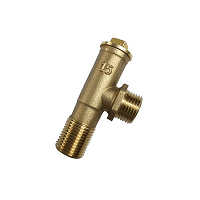
- Hex nipples are short double-male connectors joining two female-threaded parts — valves, sockets, meter unions — with a hexagonal grip for a spanner.
Sizes and threads: get both right
Brass fittings are specified by two things at once — the nominal size and the thread standard — and a mismatch in either is why a "correct" part sometimes will not seal. Household water supply work in India runs overwhelmingly on 1/2 inch (15mm) connections, with 3/4 inch appearing on feeds and 1 inch upward on risers and meters. Threads on plumbing brass here are BSP; parts sourced from mixed suppliers occasionally arrive with NPT threads that feel close but never seal properly. When in doubt, match new brass against a known-good BSP part before installation day.
- Match the fitting's nominal size to the pipe's, not to whatever is in stock.
- Saddles are sized to the main they clamp — a 32mm saddle for a 32mm distribution pipe — while the ferrule matches the service line.
- Keep one thread standard across the project; mixing BSP and NPT is invisible on the shelf and obvious at the leak.
Installing brass without ruining it
Brass is precise, and precision punishes brute force. Cross-threading a fine brass thread destroys it in a quarter turn, and over-tightening splits female fittings that would have sealed happily at snug. Start every joint by hand until it runs freely, use thread sealant appropriate to potable water, and stop tightening when firm — the sealant, not the last quarter turn, makes the seal. Where brass meets GI, treat the joint as a dissimilar-metal boundary: proper compound, correct transition part, no shortcuts. The full brass-versus-galvanised decision is covered in our GI pipe vs brass comparison.
Choosing quality brass
Weight and machining tell the story. Quality fittings feel dense for their size, have cleanly cut threads with no burrs, and carry the maker's mark and standard. For potable lines, specify lead-free grades — covered in detail in our lead-free brass range announcement. Thread standards matter too; if you are mixing sourced parts, our pipe thread standards guide will save you a mismatch.
Brass fitting quick reference
Order the full set in one go
Almost every job needs several of these types together — a connection kit is typically saddle, ferrule, adaptors, elbow and bibcock in matching sizes. Contractors who buy HDPE pipes online for the mains still do well to source their brass alongside it from one yard, so threads and sizes arrive matched to the pipe they will join. As a brass fittings supplier in Kolkata delivering to Patna and Ranchi, Metplast stocks the complete range with prices listed per unit. Send your list and we will confirm sizes, quantities and a single quote for the lot.